中文
中文 English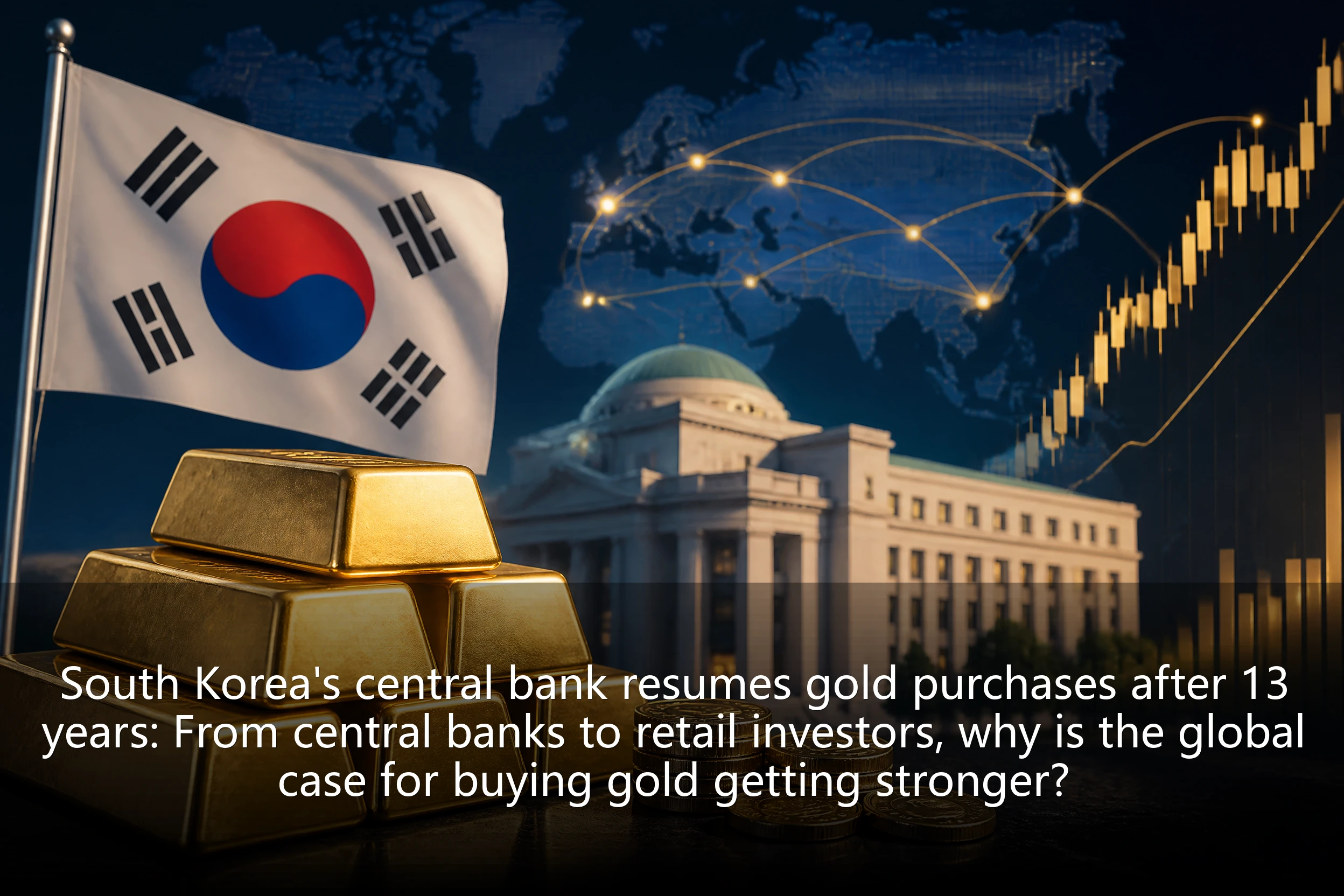
On August 4, the Bank of Korea officially announced it would resume gold reserve allocation and, for the first time, include gold ETFs in its reserve investment scope — marking the central bank's return to the gold market after 13 years since 2013. Just one day after the announcement, international gold prices surged 4.16% in a single day to reclaim the $4,300 level, posting their biggest one-day gain in nearly six months. With sovereign central banks quietly making moves and market capital accelerating back into gold, the case for buying gold has once again become a hot topic among Asia-Pacific investors.
Why is the Bank of Korea choosing to "return" now?
The Bank of Korea did not opt for a one-off large-scale buying spree this time, but instead adopted a cautious, gradual approach. According to Jeong Hee-seop, head of its reserve management department, the Bank of Korea has begun investing in physical gold ETFs and established an institutional framework for purchasing domestically produced gold: in the future, it will gradually buy domestic gold through a cooperative system involving the Korea Exchange, Korea Securities Depository, and gold producer LS MnM, among others, when market conditions and reserve management needs are appropriate. Korea Zinc will also become a qualified supplier.
Jeong stressed that gold allocation is a medium-to-long-term reserve management strategy: "We will not buy in large amounts at once, but will gradually increase gold's share in foreign exchange reserves based on medium-to-long-term needs." He also noted that as geopolitical risks have increasingly become a new normal in the global economy, gold's importance as a safe-haven asset is rising. In fact, the Bank of Korea has signaled its intention to resume gold purchases several times in recent months, making this official announcement a natural culmination.
From a reserve structure perspective, the Bank of Korea indeed has considerable room to "catch up." South Korea's official gold reserves currently stand at about 104.4 tons, ranking 40th among 100 countries globally; however, gold accounts for only 3.5% of its foreign exchange reserves, ranking 98th on the 100-country list, ahead of only Chile and Colombia. The rock-bottom gold share stands in sharp contrast to the global trend of continued central bank accumulation, explaining why South Korea has chosen to restart gold purchases now.
The "high-level lesson" of 13 years ago: the long-term case for buying gold
The Bank of Korea's previous large-scale gold purchases date back to 2011–2013. At that time, it bought a total of 90 tons of gold at an average cost of about $1,629 per ounce, spending roughly $4.7 billion. Yet nearly all of those purchases were made near the top of the previous bull market — after hitting an all-time high of $1,920.30 per ounce in September 2011, gold prices quickly entered a bear market, falling to $1,180.71 by June 2013, a cumulative drawdown of nearly 38.5%.
The sharp drop in gold prices left the Bank of Korea with an unrealized loss of about 27.5% on its gold holdings at one point, prompting lawmakers to question the then-central bank governor; by 2015, the unrealized loss had widened to around 1.8 trillion won, after which the Bank of Korea completely halted its gold purchase program. However, with gold entering a new uptrend over the past few years, the 90 tons of gold bought "too expensively" back then has now risen in market value to about $11.8 billion, an increase of roughly $7 billion over the purchase cost. The decision made back then has ultimately proven its long-term value over time — which is perhaps the most direct footnote to "why buy gold": gold's allocation value has never been judged by short-term prices alone.
Global resonance: central bank gold buying is the most solid "slow variable" for gold
The Bank of Korea's return is just the latest example of global central banks continuing to increase their gold holdings. Data from the World Gold Council shows that global central banks purchased about 289 tons of gold net in Q2 2026, up 62% year-on-year, the strongest Q2 on record. Among them, Poland's central bank led with 51 tons, raising its gold reserves to 632 tons; the People's Bank of China added 33 tons in Q2, continuing its long-term allocation pace; and Russia made modest sales of 22 tons.
Even more noteworthy is central banks' "intention." According to a World Gold Council survey, 89% of central banks surveyed expect global official gold reserves to increase further over the next 12 months, and 45% plan to continue increasing their holdings in the coming year. As a bellwether for the Asia-Pacific market, the People's Bank of China has increased gold reserves for 20 consecutive months, reaching 75.44 million ounces at the end of June, with a monthly increase of 480,000 ounces — the largest monthly rise since November 2024, and the pace has been clearly accelerating month by month.
Market analysts point out that central bank gold buying is called a "slow variable" because gold does not rely on any single sovereign credit, has global liquidity, and preserves value over the long term. In the context of normalized geopolitical conflicts, rising financial sanctions risk, and stronger demand for reserve asset diversification, gold's reserve value is being re-recognized worldwide. This structural trend will not be reversed by short-term price fluctuations; rather, it will provide stable support when gold prices fall, continuously lifting gold's long-term price center.
From central banks to retail investors: three layers of logic supporting "buying gold"
The central bank's choice provides a clear reference framework for ordinary investors. Taken together, the logic for buying gold can be broken down into at least three layers:
- Safe-haven logic: The normalization of geopolitical conflicts and the weaponization of financial sanctions have made gold's role as a "safe harbor in troubled times" increasingly prominent. The Bank of Korea's resumption of gold purchases is precisely based on the judgment that geopolitical risk has become the new normal.
- Inflation-hedging logic: With the accelerated expansion of the U.S. fiscal deficit and rising global debt levels under deglobalization, gold, as a physical asset, has a natural hedging effect against fiat currency credit. CITIC Securities research notes that three factors — U.S. fiscal deficit expansion, unbridgeable geopolitical rifts, and central bank gold buying support — determine that gold remains in a major bull market, and the recent decline is merely a temporary correction within the bull market.
- Allocation logic: Gold has low correlation with stocks, bonds, and other assets, making it an important tool for portfolio risk diversification. The recent pullback in Asia-Pacific equities has also prompted some capital to seek low-correlation assets, and gold ETFs have consequently continued to see hefty net inflows.
In fact, the "gold-buying" enthusiasm of Asia-Pacific investors is already visible. In the Chinese market, gold bar and coin consumption reached 339.336 tons in H1, up 28.42% year-on-year, making bars and coins the most popular investment category; the largest gold ETF in Asia has recorded net inflows for 16 consecutive trading days, attracting over 6 billion yuan in total. From central banks to retail investors, the forces driving gold allocation are converging.
What lies ahead? Timing and pace of buying gold
Regarding the outlook for gold prices, institutions are generally cautiously optimistic. CITIC Securities believes that around $4,000 per ounce is likely the bottom zone for this correction. As the impact of the Strait of Hormuz situation shifts from suppression to support, and with U.S. monetary policy potentially more accommodative than market expectations, gold prices are likely to return to an upward channel within the year; Deutsche Bank expects gold to rise to $4,700 per ounce by year-end; UBS forecasts gold at $4,400 in September and $4,600 in December. The World Gold Council is relatively conservative, suggesting that absent major changes in the market environment, gold prices will likely trade in a range of roughly $4,100 ±5% for the remainder of 2026.
It is important to recognize, however, that central bank buying plays more of a "price floor support" role than an engine driving sustained price increases. Driving a new trend rally still requires continued inflows from ETF, institutional, and retail capital. In the short term, after a sharp one-day rally, gold prices may well pull back to digest gains; $4,500 per ounce is a key resistance level to watch in the next phase.
For ordinary investors, the "return" of the Bank of Korea after 13 years sends a signal worth pondering: the essence of buying gold is not betting on short-term ups and downs, but understanding gold's long-term value as a "ballast stone" in turbulent times. In practice, rather than chasing rises and selling on dips, it is better to learn from central banks' approach of "buying in batches and holding for the long term," gradually building a position during pullbacks. That way, you can preserve your composure in an increasingly uncertain market.