中文
中文 English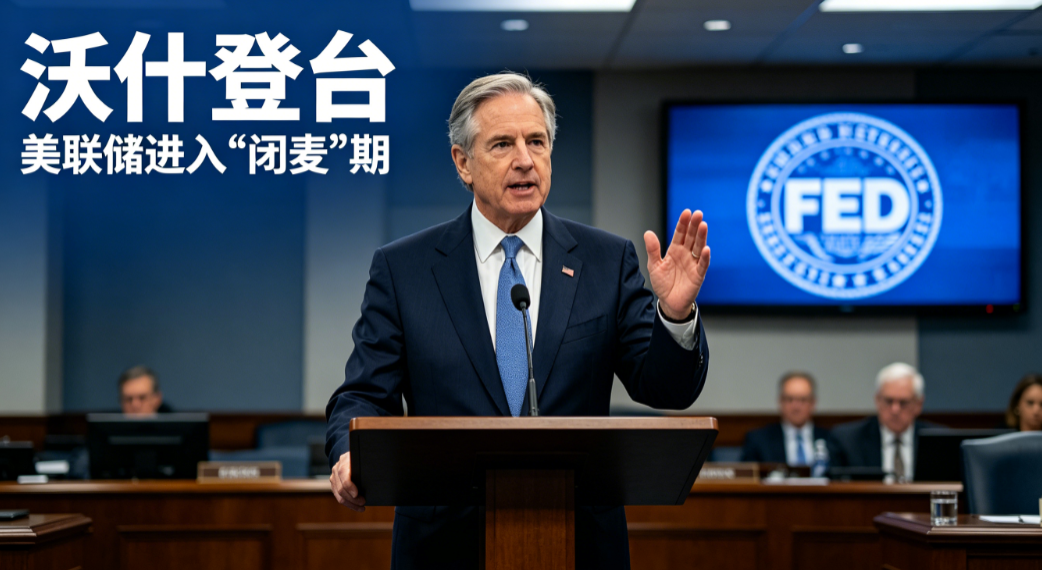
The Fed Under Warsh: From Forward Guidance to Minimal Statement
Keywords: Federal Reserve, Kevin Warsh, interest rate decision, forward guidance, dot plot, inflation, monetary policy, balance sheet
Introduction
A meeting without forward guidance, a drastically shortened policy statement, a chair who refused to provide personal forecasts – the Fed is entering an unprecedented “quiet” phase. On the 17th, the Fed announced it would keep the federal funds rate target at 3.5%-3.75%, unchanged for the fourth consecutive time, in line with expectations. But what truly drew attention was not the rate itself but the restructuring of Fed communication under new Chair Kevin Warsh.
Unlike the familiar “dove vs. hawk” battles, the core change this time is information. Warsh appears to intentionally weaken forward guidance, compress statement length, and downplay individual forecasts, trying to shift the Fed from “high predictability” to “low commitment, strong reaction.” This not only means a change in communication style but also suggests a potential restructuring of global asset pricing logic.
1. A “Minimalist” Meeting with Not-So-Minimal Signals
On the surface, this meeting was just a routine rate hold. But a closer look reveals not-so-calm signals. The post-meeting statement was only 130 words, sharply down from the previous 341, retaining only a brief description of economic conditions and a commitment to control inflation. Previously, Fed statements often gave a more complete judgment on growth, employment, and inflation, providing clues on the policy path. Now, Warsh is clearly reducing this “readability.”
More notably, Warsh did not submit personal forecasts. This means the dot plot was missing data from a key participant, which itself constitutes information change. The dot plot was traditionally an important tool for markets to gauge the Fed’s future policy lean, but now it faces marginalization. For markets accustomed to extracting policy meaning from every number, this “say less, say slower, say cautious” style undeniably increases uncertainty.
2. Inflation Becomes Key Variable Again
Behind Warsh’s policy orientation is a re-pricing of inflation risk. Although he once emphasized looking through supply shocks and expressed optimism about AI-driven long-term productivity, real data has forced a cautious policy logic. Recent US labor market remains solid, with 172K nonfarm jobs added in May and unemployment at 4.3%; meanwhile, inflation has not fully faded, with some components showing stickiness.
Latest forecasts show Fed officials raised median expectations for 2026 inflation and core inflation, while slightly lowering growth expectations. This adjustment indicates stronger vigilance within the committee about the risk combination of “high inflation, low growth.” In other words, before inflation is firmly back to target, room for rate cuts is compressed, while the possibility of rate hikes re-emerges.
Market reaction: this change has been quickly priced in. After the decision, money market expectations of a rate hike by year-end increased, US Treasury yields jumped, with the 2-year yield rising to 4.208%, a year high. Stocks fell, especially high-valuation tech sectors. This shows markets are shifting from “easing expectation trade” to “tightening risk trade.”
3. Warsh Wants to Change Not Just the Rate Path
If this meeting’s rate decision is just “step one,” what Warsh truly wants to change is the communication philosophy of the world’s most important central bank. Over the past decade, the Fed has continuously strengthened transparency and predictability, with tools like forward guidance, dot plots, press conference Q&A, and meeting minutes, aiming to stabilize expectations and reduce financial market volatility.
But Warsh has been critical of this system. He believes the Fed talks too much and commits too early, which may constrain policy flexibility and even cause decision lag. In his view, over-communication does not mean more effective communication; instead, it can lead markets to interpret every statement as policy commitment, amplifying central bank passive response risk.
Thus, he quickly signaled reform after taking office: review communication methods, balance sheet policy, data source systems, productivity and employment in the transition era, and the inflation framework itself. The review of the Fed balance sheet suggests future monetary policy must look beyond rates and reassess structural issues left from QE. The $6.7 trillion balance sheet is not just a reflection of macro liquidity but a policy toolkit that needs to be understood anew.
4. Markets Will Face a Pricing Environment Without a Map
For markets, less Fed communication is not just “less information” but a shift in pricing mode. In the past, investors could rely on statement wording, dot plots, and chair speeches to deduce the rate path; under the new framework, they must rely more on current data, single statements, and real-time macro changes to judge policy direction.
This has two consequences. First, policy flexibility increases; the central bank can adjust faster based on real data without being bound by previous commitments. Second, market volatility may rise because with the loss of a stable forward anchor, short-term rates, long-term yields, and risk asset prices may react more strongly to single data points or wording changes.
In this sense, Warsh is pushing not just a communication contraction but a rebalancing of policy framework: from “tell the market in advance” to “react based on reality.” This would bring monetary policy back to more typical central bank logic – less narrative, more action; less prediction, more judgment.
5. The “Lean Against the Wind” Philosophy Is Returning
Warsh’s criticism of a data-dependent model also deserves attention. The Fed increasingly emphasized real-time data tracking, but this also creates policy lag: by the time data confirms risk, the economy often has already changed significantly. He advocates rebuilding the data framework and introducing more unique data sources to allow earlier identification of turning points and reduce the passivity of “seeing when it’s too late.”
This thinking is essentially a “lean against the wind” philosophy: hike earlier when necessary, cut earlier when necessary, stay steady when appropriate. It is not fully aligned with traditional central bank transparency trends but fits a more realistic judgment – in an era of high uncertainty, central banks may not need to say more but must judge faster and more accurately.
Of course, this shift also carries risk. If the Fed reduces information disclosure but fails to fill the gap with higher-quality judgments, markets may face greater divergence due to uncertainty, leading to more frequent sharp fluctuations in yield curves, dollar index, and risk assets.
Conclusion
Warsh’s first meeting was on the surface a “no hike, no cut” bland decision, but in reality it was a major turning point in Fed policy communication. The minimalist statement, absent personal forecast, shortened press conference, and weakened forward guidance together constitute a more restrained, more introverted Fed that is harder for markets to price in advance.
This means global markets will face not only rate changes themselves but also a central bank that no longer wants to over-explain itself. For investors, this may mean higher uncertainty; but for the Fed, it may be exactly the way to regain policy initiative.
A more “introverted” Fed is coming. It is no longer eager to provide answers but chooses to leave room between data and reality. The question is whether markets are ready to move forward without a map.